A Blue Star cold room cannot be specified safely from its brand name, room volume, or controller setpoint alone. You need to match the equipment configuration to the product, calculate the complete heat load, detail the insulated envelope and services, and define acceptance tests before installation begins.
Key takeaways
- Request the exact Blue Star model, refrigerant, capacity, controls, and datasheets.
- Set storage temperature from the product requirement, not the room name.
- Calculate product, infiltration, wall, lighting, people, and equipment loads.
- Make the quotation state measurable temperature, humidity, airflow, and recovery performance.
Identify the Blue Star configuration and the temperature your product actually needs
A quotation must identify the proposed Blue Star cold room model and complete equipment configuration, not merely call it a cold room. Require the condensing unit, evaporator, refrigerant, controls, rated capacity, design ambient, and operating range; ask for exact model datasheets before comparing prices.
| Configuration | Target condition | Main requirement |
|---|---|---|
| Chilled storage | Chilled storage temperature commonly 0 to 5°C | Product-specific hygiene and humidity control |
| Frozen storage | Frozen storage temperature range generally −18°C or colder | Stable holding temperature and limited door exposure |
| Deep-freeze storage | Deep-freeze storage below −18°C, often around −30 to −40°C | Lower evaporating temperature and suitable insulation |
| Controlled ripening | Commodity-specific temperature, humidity, oxygen, carbon dioxide, or ethylene | Controlled ripening process, not simple storage |
Room air temperature does not equal product core temperature. A room reaching 0°C does not prove newly loaded goods have cooled safely. Put product-entry temperature, packaging, stacking pattern, maximum loading rate, allowable pull-down time, and final product core temperature in the specification.
Fruits and vegetables need humidity and airflow that limit wilting and dehydration. Dairy, meat, seafood, pharmaceuticals, and flowers require different temperature, hygiene, airflow, and air-velocity limits.
Blue Star cold room features should be checked against inventory, not brochures. Ask whether the supplier is an authorised Blue Star partner, reseller, system integrator, or installer using Blue Star equipment, and require written model documentation, warranty scope, and service responsibility.
Size the room from product flow and the complete refrigeration load
Size the room from internal length, width, and height, then size the equipment from the complete refrigeration load. Room volume alone cannot show whether the system will cool warm deliveries fast enough.
Allow for usable pallet positions, rack orientation, aisle width, pallet clearance, evaporator clearance, door swing, and space for people, pallet trucks, and maintenance access. Draw the loaded plan before selecting the panel dimensions or equipment.
Record these design inputs:
- Daily throughput, product mass per delivery, product loading temperature, packaging, stacking pattern, and required product pull-down time.
- Door-opening frequency, each opening’s duration, traffic direction, pressure differences, strip curtains, self-closing hardware, and any vestibule.
- Design ambient temperature, operating hours, defrost schedule, and the planned future increase in throughput.
Request a refrigeration load calculation in kilowatts. It must separate product pull-down or freezing load, transmission load through panels and the floor, infiltration load through doors, occupants, lighting, evaporator fans, defrost heat, drain or door heaters, and every other internal equipment load.
A room holding goods that arrive already chilled can need radically less capacity than one cooling warm goods. Confirm the product-entry temperature and product pull-down time; room air reaching its setpoint does not prove that the product core has reached its target.
Ask for the design safety margin and the assumptions behind every load. Reject a proposal showing only compressor horsepower or a nominal cubic-metre rating. Defrost and heater loads also affect feeder size, generator capacity, demand charges, and heat entering the room.
Check the insulated envelope, freezer floor, doors, and moisture protection
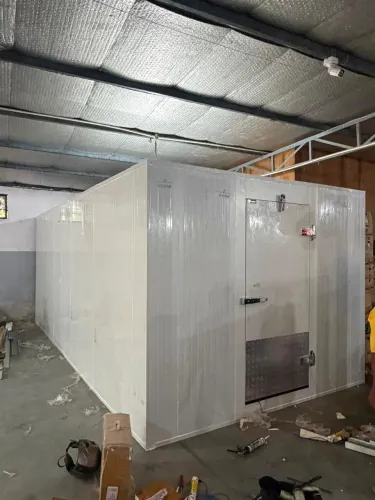
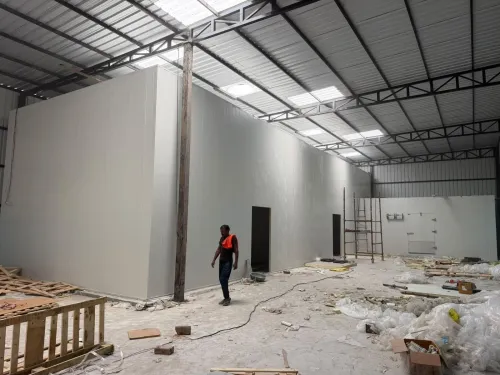
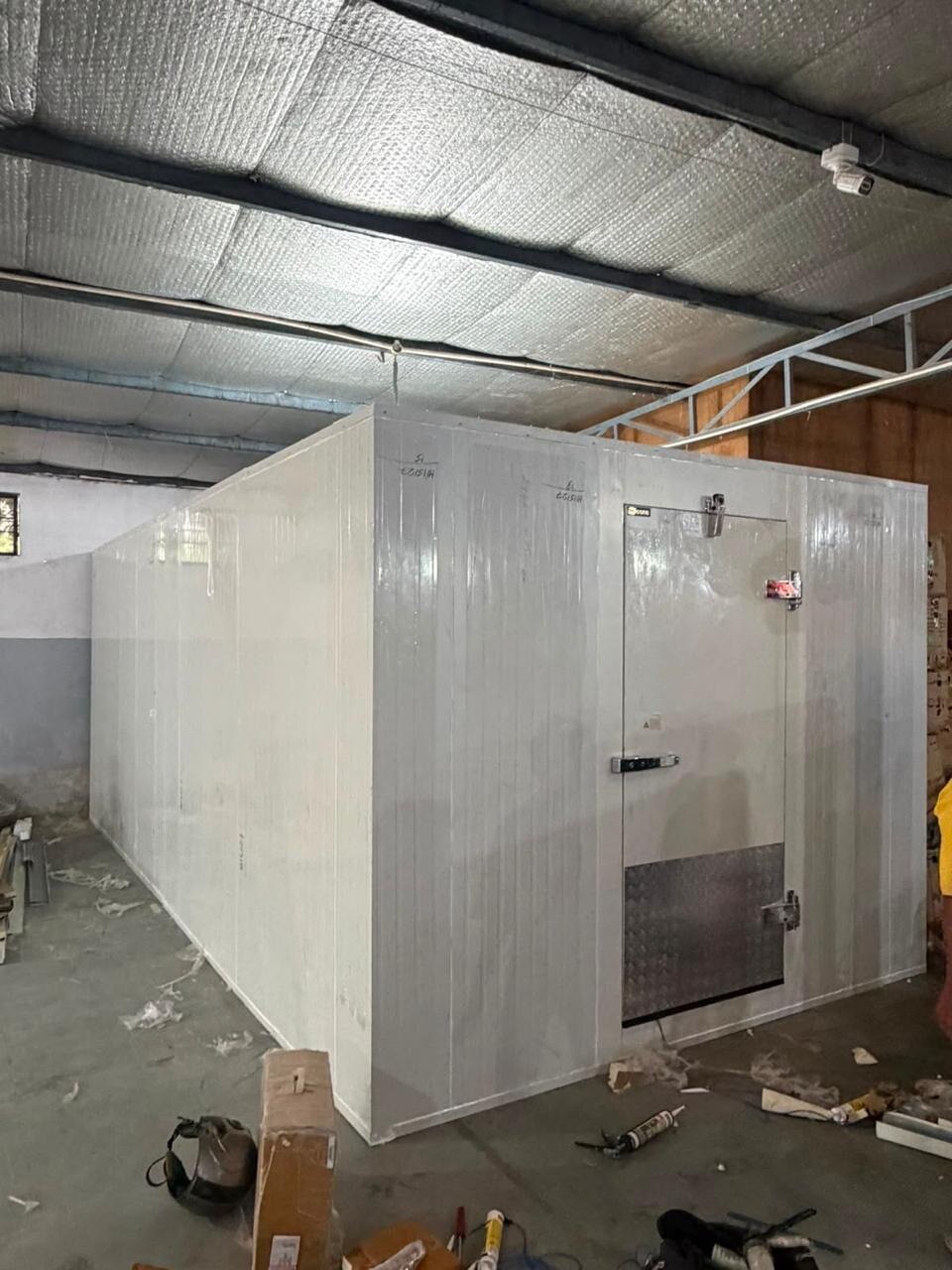
Temperature retention depends on the envelope, not the room volume alone. Compare PUF panel density, cold room panel thickness, and declared thermal conductivity; higher density does not compensate for inadequate thickness or poorly sealed joints. Specify washable interior surfaces, cam-lock joints, sealed corners, and a documented detail for every service penetration.
| Feature | Check before approval | Failure if ignored |
|---|---|---|
| PUF panels | Density, thickness, thermal conductivity, washable finish | Heat gain, hygiene problems |
| Joints and corners | Cam-lock engagement, sealant, vapour barrier continuity | Moisture entry and hidden ice |
| Penetrations | Sleeves, collars, sealant, written thermal-bridge treatment | Condensation and local frost |
| Floor | Insulation below the slab and at edges | Frost heave and slab damage |
A freezer needs under-slab insulation plus a designed method of stopping subsoil freezing. Select electric or glycol freezer floor heating, a ventilated subfloor, or another frost-protection system for the floor design and climate. Without it, frost heave can crack the slab, distort doors, and break panel seals.
Treat doors as refrigeration capacity. Record opening frequency, open duration, traffic direction, self-closing hardware, strip curtains, pressure differences, and any vestibule. Specify a heated freezer door frame and threshold where icing is possible.
Decide drainage before construction. Slope, insulate, and heat-trace freezer drain pans, traps, outlets, and discharge lines where required; use controlled condensate collection when protected drainage is impractical. Seal every penetration without interrupting the warm-side vapour barrier.
Match humidity, airflow, evaporator selection, and defrost to product quality
Protect the product, not merely the room air: specify a product-core target, intended relative humidity, or allowable product weight loss alongside the room setpoint. For cold room humidity control, use a small air-to-refrigerant temperature difference where quality demands it; a larger difference reduces coil size but increases drying, shrinkage, and frost.
Defrost method must match room temperature, moisture load, coil design, and operating schedule.
| Defrost method | Suitable application | Main consequence |
|---|---|---|
| Off-cycle defrost | Warmer rooms with limited frost | Simple operation, but inadequate for heavy ice |
| Electric defrost | Colder rooms or heavier frost loads | Adds heater heat, electrical demand, and recovery time |
| Hot-gas defrost | Frequent defrost with suitable refrigeration design | Requires extra piping, controls, oil-return arrangements, and safety measures |
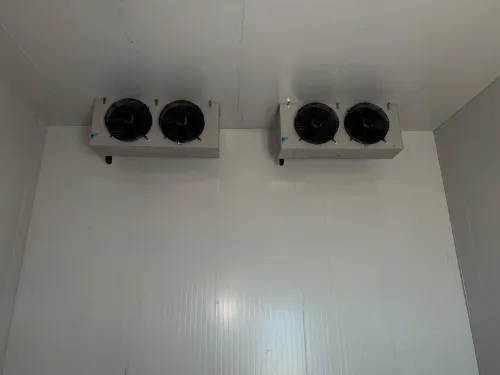
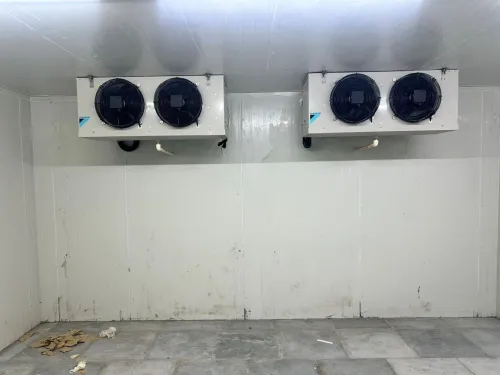
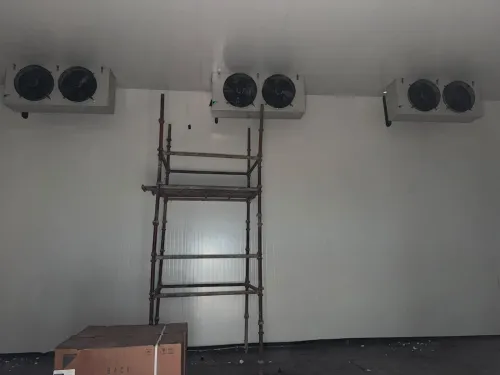
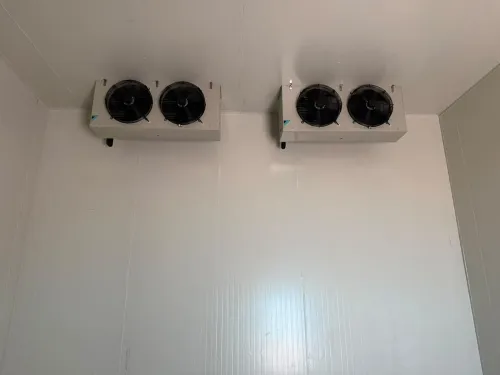
Verify evaporator capacity, coil face area, fan speed, air throw, and cold room airflow against pallet height, ceiling clearance, rack orientation, coil clearance, and return-air paths. Good air circulation in cold room layouts prevents blocked returns and hot spots; excessive direct velocity can dehydrate exposed products or disturb packaging.
Complete temperature mapping under representative loading with calibrated instruments at corners, door-adjacent areas, high and low storage levels, and the warmest observed locations. Record pull-down time, steady-state uniformity, defrost recovery, alarm setpoints, and power-failure behaviour, then test both air temperature and product-core response before acceptance.
Turn the installation quotation into a verifiable performance specification
1. Put measurable results in the purchase specification, not “reliable cooling.” State the design setpoint, product core target, maximum pull-down time, allowable temperature variation, humidity range, loading pattern, temperature alarm setpoints, and defrost recovery time.
A cold room installation checklist must also identify where sensors sit and how the room will be tested under representative loading.
2. Demand a cold room electrical schedule covering compressors, evaporator fans, defrost heaters, drain-line and door-frame heaters, crankcase heaters, controls, alarms, standby equipment, and generator demand. Compressor nameplate power is incomplete: heater and defrost loads can change feeder size and backup-generator capacity.
Confirm the refrigerant, local restrictions, leak-control records, technician qualifications, recovery equipment, replacement availability, and expected service cost. Document the refrigerant safety requirements for its charge, occupancy, and equipment location, including detection, ventilation, emergency controls, pressure-relief discharge, and charge limits.
3. Make cold room acceptance testing a handover condition. Require calibrated instruments and test records from corners, door-adjacent areas, high and low storage levels, and the warmest locations, including pull-down time, uniformity, defrost recovery, alarm response, and a power failure test. Obtain calibration certificates, wiring diagrams, maintenance intervals, spare-parts details, and response contacts.
Ask ICETECH ENGINEERS to state in writing whether it is a Blue Star authorised partner, reseller, integrator, or installer using Blue Star equipment, then submit model-specific calculations, drawings, commissioning records, and service commitments.
Related product
 | Blue Star Cold Room ICETECH ENGINEERS offers high-quality Blue Star Cold Room solutions for commercial and industrial refrigeration applications. View product → |
Frequently asked questions
What Blue Star cold room configuration details should a quotation include?
Request the exact model and datasheets for the condensing unit, evaporator, refrigerant, controls, rated capacity, design ambient, and operating range.
How do you determine the correct cold room temperature?
Start with the product’s required storage temperature, humidity, and allowable exposure time, then select equipment that maintains those conditions under the design load.
What loads must be included when sizing a cold room?
Include product pull-down or heat load, transmission through panels and the floor, door infiltration, lighting, people, fans, defrost, and other equipment inside the room.
Which cold room construction details should you verify before installation?
Check panel insulation, joints, vapour sealing, floor insulation and loading, door seals, thresholds, drainage, and protection against condensation and moisture migration.
What should a cold room performance specification contain?
State the operating temperature range, humidity target, airflow, defrost method, design ambient, pull-down or recovery requirement, alarm limits, and acceptance-test method.