A freezer room can display the correct thermostat reading while product at a pallet centre remains too warm. You will be able to define the temperature requirement, calculate the real cooling load, specify the envelope and refrigeration system, and verify performance under operating conditions rather than accepting an unspecified “ideal” temperature.
Key takeaways
- Set product core, room-air and alarm limits before choosing equipment.
- Size for product load, traffic and required pull-down time.
- Seal panels, floors and doors against heat and moisture entry.
- Map temperatures and test alarms, power failure and recovery before handover.
Define the product temperature, room range and alarm limits first
Design the freezer room to maintain a frozen product holding temperature of -18 °C product core temperature or colder throughout storage. That does not mean every point in the room air must be -18 °C.
Set the freezer room set point below the product requirement by calculating the refrigeration load, pull-down performance, infiltration and heat entering through the envelope.
Write the specification with three separate controls:
- Product target: State the required core temperature for each product category, including any requirement colder than -18 °C. Verify it in the product or a validated product simulator, not from room air alone.
- Room target: Define the normal air temperature range, allowable fluctuation and recovery time after door openings, loading or defrost. A single thermostat setpoint hides unacceptable warm periods.
- Alarm limits: Set high and low alarms against the validated room range and the time needed to protect the product. Record the alarm delay, notification route and action required after an excursion.
Select probes and recorders for the actual operating range. EN 12830 covers temperature recorders used for storing temperature-sensitive goods, while EN 13486 covers verification of recorders and thermometers. Calibrate and map sensors after installation; one accurate probe at the evaporator cannot prove uniform temperatures across racks, door zones and product locations.
Size the room for product load, traffic and pull-down time
Start with the kilograms entering and leaving each day, not the room’s internal volume. For freezer-room sizing, map pallets or racks, required clearances, aisles, evaporator space, door swing and service access; then separate usable storage volume from the larger construction envelope.
A product load calculation must use incoming product mass, entry temperature and the required pull-down time.
| Load source | Measure | Calculation input |
|---|---|---|
| Product | Kilograms per batch and entry temperature | Product enthalpy removed ÷ pull-down time |
| Envelope | Wall, ceiling and floor areas | Insulation performance and adjacent-room temperatures |
| Traffic | Door size, openings per hour and duration | Door-opening infiltration load, including humidity |
| Internal heat | Lights, fans, heaters and people | Rated watts multiplied by operating hours |
| Defrost | Heater or hot-gas input | Heat released to the room and recovery time |
Size the refrigeration system for the combined peak, not the average daily load. Add the heat from heated door frames, thresholds and floor protection; these prevent icing but consume electrical power.
Frequent traffic can make infiltration larger than transmission through the panels, so calculate an ante-room, strip curtain or rapid-roll door if the opening load drives capacity.
Check the selected unit at its actual evaporating temperature, condensing condition and defrost recovery—not its catalogue rating at warmer conditions. A room that reaches its setpoint with no product inside can still leave a full delivery warm if the pull-down load and recovery time were omitted.
Build the envelope, floor and doors to stop heat and moisture entry
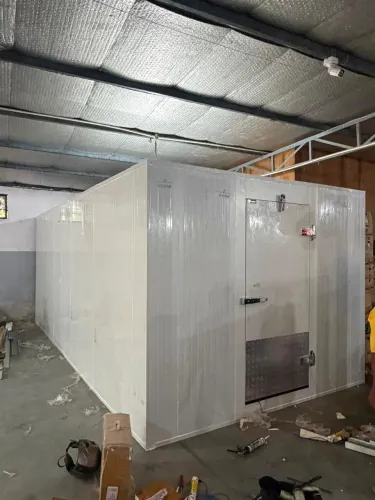
A continuous warm-side vapour barrier prevents humid air from entering the insulation and condensing inside it. Seal every panel joint, corner, door frame, pipe, cable and light penetration; a high-performance panel fails if one unsealed opening creates concealed ice and reduces insulation performance.
Specify and inspect these envelope details:
- Select freezer insulation thickness from the design temperature difference, panel conductivity and heat-load calculation, not from a standard panel catalogue.
- Use staggered joints, sealed cam-locks and compatible vapour-sealant so thermal bridges do not run continuously through the wall, ceiling or wall-to-floor junction.
- Continue the thermal break around corners, structural supports and the door threshold; exposed metal members can conduct heat into the room and form icing paths.
- Keep the vapour barrier on the warm side, with sealed overlaps and compression details that remain intact after installation.
The insulated freezer floor construction must place insulation beneath and around the slab, protect the wall-to-floor joint and route meltwater to a drain where required.
Where ground conditions create frost-heave risk, install monitored electric or glycol underfloor or perimeter heating; a failed system can freeze the sub-slab ground, lift the slab and damage racks or doors.
Use self-closing doors, and add an ante-room, strip curtains or rapid-roll door when traffic is frequent. Heat door frames and thresholds where icing is likely, but include that electrical heat in the refrigeration load. Give evaporator drains continuous fall, suitable traps and heat tracing so they do not freeze shut.
Match the evaporator and condensing unit to real operating conditions
Choose the evaporator and condensing unit for the worst operating case, including pull-down, door traffic, defrost recovery and low ambient conditions. Verify evaporator capacity at actual evaporating temperature and design condensing conditions; a catalogue rating at a warmer evaporating temperature can leave inadequate capacity and create long recovery times.
Condensing unit selection must include capacity lost during defrost, fan heat, heated door frames and thresholds, transmission, infiltration and lighting. High-use openings need self-closing doors, and may also require an ante-room, strip curtains or rapid-roll doors. Count every heat source.
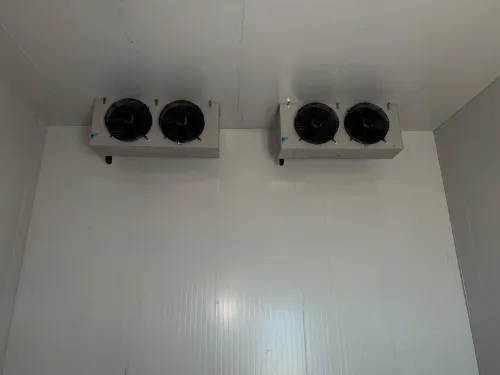
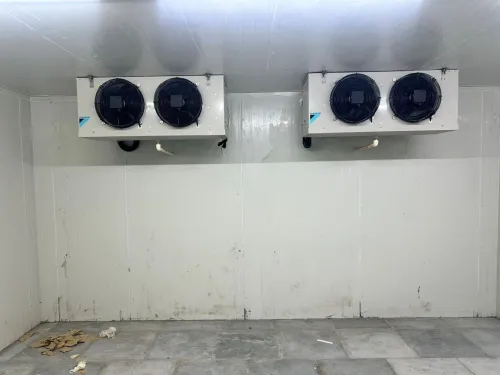
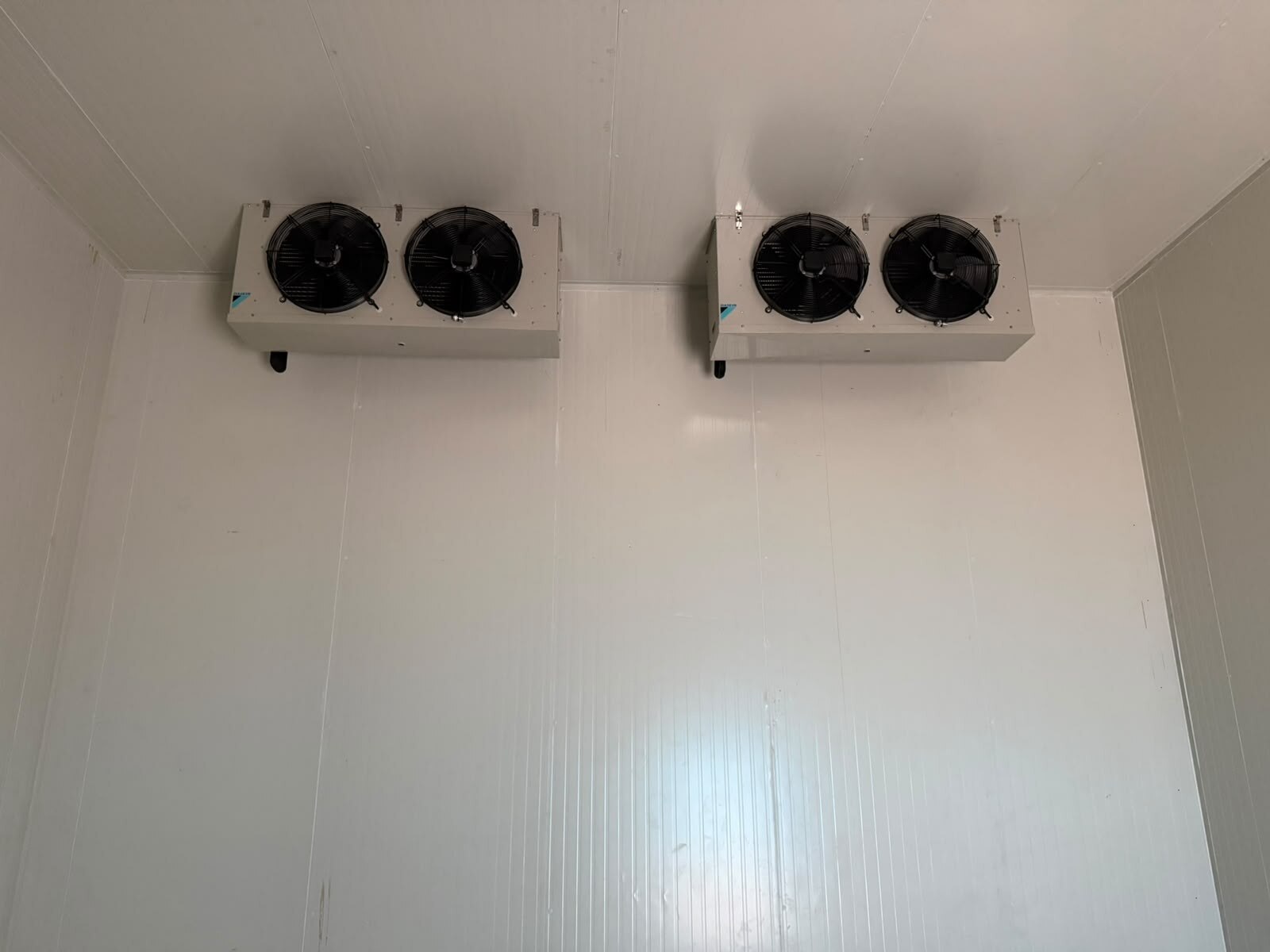
Freezer air distribution must move air around pallets without short-circuiting from discharge to return. Keep the manufacturer’s clearances at the evaporator inlet and outlet, and leave rack gaps that prevent blocked circulation. A room-average sensor can show the correct temperature while pallet corners develop warm spots.
Compare defrost options against the room, product and drainage design:
| Method | Strength | Requirement |
|---|---|---|
| Electric | Simple control and installation | Add heater load and protect product from excessive surface warming |
| Hot gas | Faster recovery with lower direct electrical heat | Provide suitable piping, controls and oil management |
| Water | Effective coil ice removal | Provide controlled drainage and prevent re-freezing |
Specify the defrost method and drain heat tracing together. Give evaporator drains a continuous fall, suitable traps or pressure-control details, and frost protection wherever pipework crosses cold space. A drain that works at commissioning can freeze shut later, flooding the room during defrost.
Commission the installation with mapped temperatures and failure tests
Prove protection under operating conditions, not only with the door closed at steady state. Temperature mapping must record room air and product or simulated-product temperatures, because a room-air reading of -18 °C does not prove that product cores meet -18 °C or colder.
- Run an empty-room pull-down test and record the time to reach the specified range.
- Repeat with the planned pallet load or a validated simulated load, measuring the warmest locations and product centres.
- Open doors at the expected traffic rate, then confirm recovery time, alarm activation and self-closing action.
- Observe a complete defrost cycle, including coil temperature, termination, drip time, fan restart and any meltwater reaching product.
- Test the high-temperature, power-failure and sensor-failure alarms, plus floor heating and drain protection.
Use recorders and probes suited to the operating range and monitoring application. EN 12830 covers temperature recorders for temperature-sensitive goods; require EN 13486 verification for recorders and thermometers. Installation calibration alone cannot prove uniformity.
Specify the mapping grid, probe locations, sampling interval, test duration and pass/fail limits in the commissioning report. A time-only defrost can leave ice on a high-infiltration coil or waste energy in a lightly loaded room.
Check continuous drain fall, traps, heat tracing and fan delay, since a drain that works on day one can later freeze shut. ICETECH ENGINEERS can be required to deliver these records before handover.
Related products
 | Cold Room Manufacturer ICETECH ENGINEERS is a leading Cold Room Manufacturer in India, specializing in the design, manufacturing, supply, and installation of... View product → |
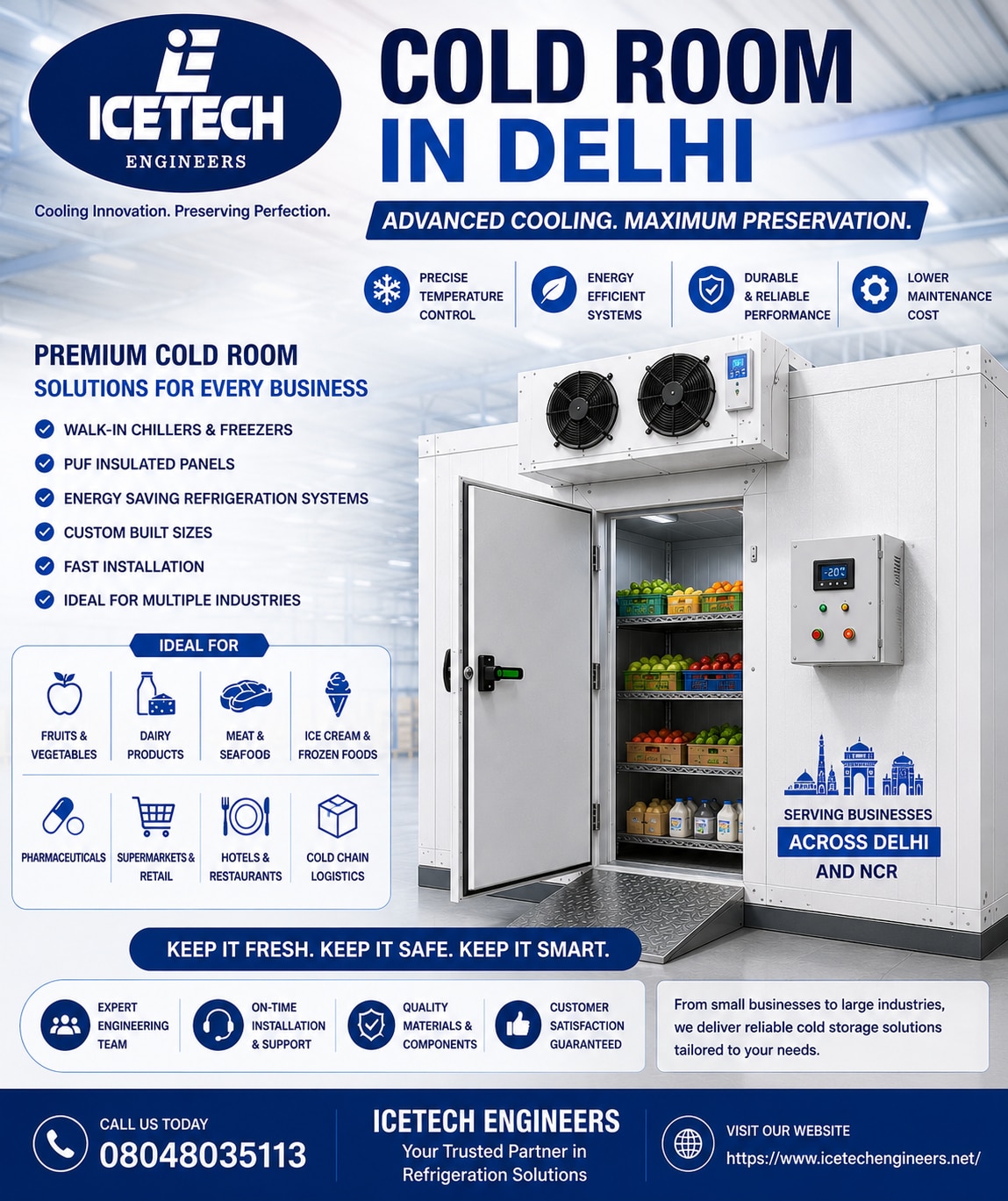 | Cold Room in Delhi ICETECH ENGINEERS is a trusted Cold Room Manufacturer in Delhi, offering advanced temperature-controlled storage solutions for commercial and... View product → |
Frequently asked questions
What temperature should frozen products reach in storage?
Design storage to maintain a frozen product core temperature of -18 °C or colder. Room air does not need to be -18 °C at every point.
What information is needed to size a freezer room?
Define the product load, incoming product temperature, traffic through the doors and required pull-down time before sizing the room and refrigeration equipment.
How do you prevent heat and moisture from entering a freezer room?
Use a continuous insulated envelope, a suitable insulated floor and properly sealed doors. Check joints, thresholds and door openings for leakage paths.
How should freezer-room refrigeration equipment be selected?
Match the evaporator and condensing unit to the actual product load, room conditions, door traffic and pull-down requirement rather than room volume alone.
What tests should be completed before a freezer room is accepted?
Map temperatures at multiple locations and test alarms, power failure response and temperature recovery under representative operating conditions.