A large cold room fails when its refrigeration load, floor, airflow and handling pattern are treated as separate problems. You will be able to set the design basis, compare storage layouts, specify the enclosure and refrigeration package, and verify performance under a realistic loading schedule.
Key takeaways
- Build a load schedule covering product, transmission, infiltration, defrost and equipment heat.
- Reserve airflow clearances around pallets, evaporators, walls and ceilings.
- Specify plant performance at design conditions, not catalogue cooling capacity alone.
- Require temperature mapping, alarm tests and commissioning records before handover.
How do you calculate the real refrigeration load for a large cold room?
A real cold room load calculation starts with a load schedule, not room volume. Separate transmission load through panels, product cooling, air infiltration load, occupants, lighting, evaporator fan motors, defrost re-evaporation and other equipment heat.
- Define product type, daily mass received, entering temperature, packaging, loading pattern, target product-core temperature and product pull-down time.
- Calculate sensible cooling with Q = m × cp × ΔT ÷ time. Add latent heat of freezing when product crosses its freezing point.
- State design door-opening duration, forklift traffic, occupancy, lighting hours and ambient temperature. Include respiration heat for fresh produce.
- Check the warmest receiving condition separately; warm incoming pallets need a separate product pull-down calculation from the storage duty.
| Commodity | Storage design condition | Receiving or pull-down condition |
|---|---|---|
| Chilled produce | 0–4°C; 90–95% relative humidity | Warm field or transport pallets; calculate pull-down and respiration heat |
| Dairy | 2–4°C | Product-specific receiving temperature and pull-down time |
| Fresh meat | 0–2°C | Warm carcasses or cartons require separate pull-down duty |
| Frozen food | −18°C or colder | Freeze-load calculation, including latent heat |
| Pharmaceuticals | 2–8°C, or the validated label range | Follow validated receiving limits and excursion controls |
Room-air setpoint does not prove product safety. Place calibrated pallet-core probes in representative dense and edge loads, then perform thermal mapping during actual receiving, door opening and defrost conditions. Averages can hide warm pallets.
How should you size pallet capacity, airflow space and temperature zones?
Start with usable room volume: multiply clear internal length, width and height, then subtract columns, evaporator envelopes and unusable corners. Convert stock and daily movement into pallet positions using recorded pallet length, width, height and mass; do not estimate capacity from floor area alone.
Reserve handling space next. Specify the forklift model, load centre and turning radius, then set cold room aisle width from that forklift’s manufacturer requirement rather than a generic allowance. Check rack clearance beside walls, above pallets, below evaporator discharge paths and around return-air openings.
Set maximum stack height below the lowest structural, sprinkler, service and ceiling limit. Preserve rack safety and return-air paths, then test the loaded layout.
| Option | Throughput and operating effect | Main trade-off |
|---|---|---|
| One large room | High shared throughput with simple handling | Commodities must be compatible; one fault affects all stock and part-load efficiency falls |
| Multiple temperature zones | Separates hygiene, commodity and temperature needs while improving redundancy and part-load operation | More doors, controls, refrigeration circuits and handling complexity |
| Dedicated blast freezer room | Freezes incoming product rapidly without warming stored inventory | Requires separate high-capacity refrigeration, airflow and loading control |
Use a blast freezer room when incoming product must freeze rapidly; storage evaporators are not a substitute. Add an ante-room or vestibule where door traffic drives infiltration, and separate receiving and dispatch chambers when hygiene or cross-contamination risk requires directional flow.
Verify airflow after racking and loaded pallets are installed. An empty-room test can miss blocked returns, supply-to-return short-circuiting and warm pockets.
What enclosure, door and floor details prevent heat gain and structural failure?
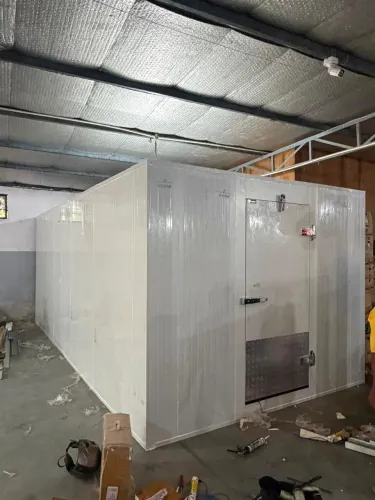
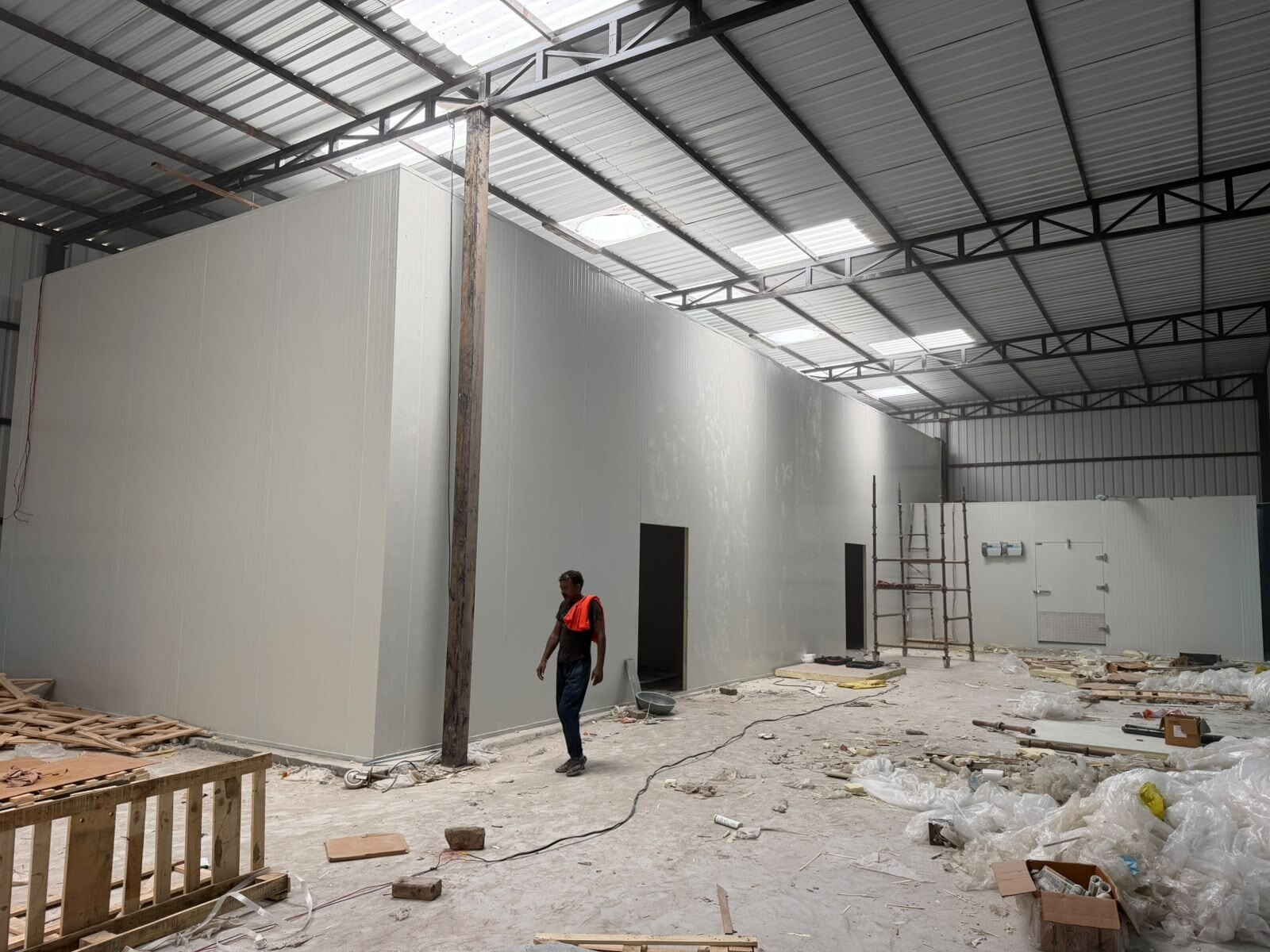
Choose PUF panel thickness from calculated heat flow, design temperature difference and declared installed U-value, not room size. Request panel density, joint construction, cam-lock details, facing material, hygienic finish and performance evidence such as EN 14509 where applicable. Installed performance must account for joints, fasteners, compression and thermal bridges.
Maintain vapour barrier continuity on the warm side across joints, corners, door frames, service penetrations and panel-to-floor interfaces. Seal compatible penetrations, thermal bridges and damaged facings; moisture paths will increase heat gain and degrade insulation.
Door choice depends on use, not preference.
| Door type | Best comparison point | Main control |
|---|---|---|
| Hinged | Low opening frequency and limited traffic | Insulated threshold and tight seals |
| Sliding | Frequent traffic and wider clear openings | Track space, seals and closing discipline |
| High-speed or strip system | Repeated forklift movement | Reduce open time; neither removes infiltration |
| Air curtain or vestibule | Pressure and traffic control | Use with a closing door |
Specify clear door dimensions, a strip curtain where suitable, a high-speed door or air curtain, and a heated freezer door frame for frozen rooms. Use an insulated threshold and loading protocol that limits open time.
Design cold room floor insulation for forklift wheel loads, rack-leg loads, slab joints, drainage, slope and anti-slip cleaning. Include warm-side vapour protection, edge insulation and frost-heave prevention. Require underfloor heating or another sub-slab frost-protection system whenever freezing beneath the insulated floor could lift the slab or damage racks.
Transfer rack, suspended evaporator and impact-barrier loads through engineered structural details, never insulated panels.
How do you specify the refrigeration plant rather than compare catalogue capacity?
A quotation is comparable only when every compressor and evaporator uses the same rating basis. Require these fields: refrigerant, design evaporating temperature, condensing temperature, superheat, liquid temperature, fan operation and frost condition. Catalogue tonnes or kilowatts alone are not an adequate comparison.
| Specify | Why it changes selection | What to request |
|---|---|---|
| Compressor control | Full-load sizing can waste energy at low demand | Compressor staging, part-load control, duty-standby arrangement and failure alarms |
| Liquid circuit | Poor feeding causes unstable capacity and oil or liquid problems | Receiver size, liquid-line design and independent circuits |
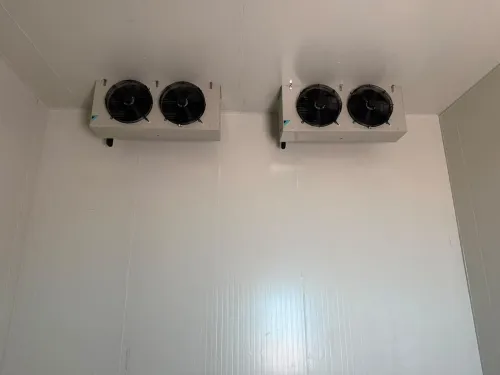
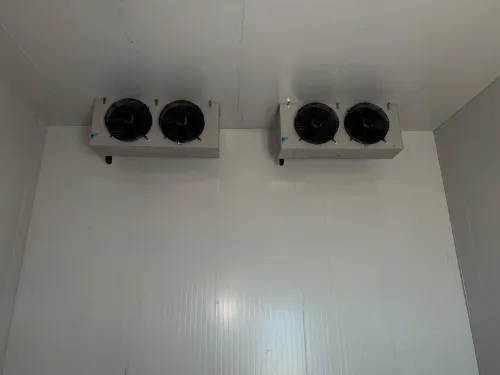
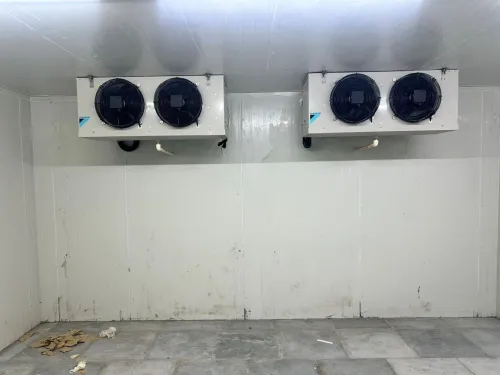
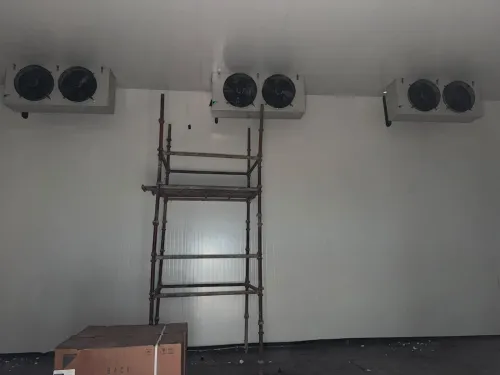
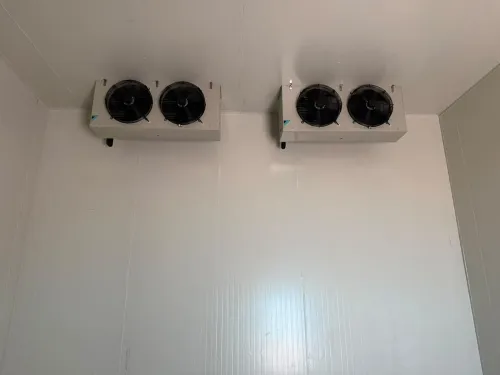
| Evaporator | Airflow and humidity affect product quality | Placement, air velocity, evaporator fin spacing and room humidity target |
| Defrost and drainage | Frost blocks airflow; frozen condensate disables the room | Electric, hot-gas, water or off-cycle defrost; heated drain pans or lines, slope and an outlet that prevents refreezing |
Select defrost against coil temperature and frost load, not habit. Excessive air velocity increases dehydration, while narrow evaporator fin spacing loses airflow quickly under frost.
Establish refrigerant safety before equipment layout. Ammonia, carbon dioxide, hydrocarbons and A2L refrigerants alter ventilation, detection, relief, charge-limit, electrical and emergency-response requirements. Place condensers where ambient airflow, noise, maintenance access and summer condensing conditions support the selected capacity. For critical inventory, also compare emergency power and independent circuits.
What must installation, monitoring and commissioning prove before handover?
A cold room is ready for handover only when it protects product under the worst planned loading condition, not merely when empty-room air reaches its setpoint.
1. Use a cold room commissioning checklist to record pressure and leak testing, evacuation and dehydration, refrigerant-charge verification, oil-return checks, insulation inspection, door operation, defrost cycles, drain heating and condensate discharge.
2. Calibrate every temperature sensor and place probes at critical product locations, including pallet cores and warm-air risk zones. One return-air sensor cannot reveal a hot pallet centre.
3. Install independent or validated data logging. Verify recorder performance against EN 12830 requirements for temperature recorders and EN 13486 verification procedures.
4. Test high- and low-temperature alarms, door-open alarms and communication-failure alarms. Document the response limit, escalation contact, acknowledgement time and corrective action for each alarm.
5. Run the room empty and loaded, then complete temperature mapping with representative pallet-core probes during the actual receiving and dispatch pattern. Record pull-down time, suction stability, product temperatures, humidity, fan operation and defrost recovery.
6. Require one coordinated handover package: load calculation, layout drawings, panel and floor details, equipment rating conditions, controls narrative, test records and maintenance schedule. ICETECH ENGINEERS can be asked to supply these engineering documents together rather than as disconnected equipment paperwork.
Reject handover if product temperatures, pull-down time, alarm response or defrost recovery fail at planned throughput, even when the room air remains within its setpoint.
Related products
 | Commercial Cold Room ICETECH ENGINEERS is a trusted name in designing and manufacturing high-performance Commercial Cold Rooms for businesses that require precise... View product → |
 | Cold Room ICETECH ENGINEERS is a leading Cold Room Manufacturer, Supplier, and Installation Company in India, offering high-performance cold room solutions for... View product → |
Frequently asked questions
How do you calculate the real refrigeration load for a large cold room?
Create a load schedule that separates transmission through panels, product cooling, air infiltration, occupants, lighting, evaporator fan motors, defrost re-evaporation and other equipment heat.
How should you size pallet capacity, airflow space and temperature zones?
Set pallet positions alongside required clearances for airflow, evaporator discharge, walls, ceilings, doors and safe access. Divide storage into temperature zones when products have different storage requirements or loading patterns.
What enclosure, door and floor details prevent heat gain and structural failure?
Specify insulated panels with sealed joints, correctly detailed doors and thresholds, vapour control, impact protection and a floor designed for rack, pallet, traffic and thermal loads.
How do you specify the refrigeration plant rather than compare catalogue capacity?
Compare plant output at the room temperature, ambient condition, refrigerant, suction temperature, defrost cycle and operating duty stated in the design basis—not a catalogue rating alone.
What must installation, monitoring and commissioning prove before handover?
Handover should include installation checks, sensor and alarm tests, temperature mapping, defrost verification, pull-down or operating trials, setpoint records and documented evidence that the room meets its design conditions.
Related products
 | Cold Storage Room ICETECH ENGINEERS is a leading manufacturer and supplier of high-performance Cold Storage Rooms designed for businesses that require reliable... View product → |
 | Cold Room Manufacturer ICETECH ENGINEERS is a leading Cold Room Manufacturer in India, specializing in the design, manufacturing, supply, and installation of... View product → |
 | Cold Room Indoor Unit ICETECH ENGINEERS is a leading manufacturer and supplier of premium-quality Cold Room Indoor Units designed to deliver efficient and uniform cooling... View product → |
 | Ice Cream Cold Storage Room ICETECH ENGINEERS is a trusted manufacturer and supplier of Ice Cream Cold Storage Rooms designed to maintain the ideal freezing temperature for... View product → |